9 ways to set realistic SEO expectations with your clients


Table of Contents
- Key takeaways
- Why your agency needs to set realistic expectations for search engine optimization
- Other common misconceptions about SEO
- 9 tips for setting realistic SEO expectations
- 1. Educate clients about SEO basics
- 2. Clarify the SEO timeline
- 3. Talk about the relevance of SEO
- 4. Don’t make SEO too abstract
- 5. Communicate possible risks
- 6. Be open about your agency’s limitations
- 7. Talk about the goals and expectations of SEO
- 8. Share regular SEO reports
- 9. Let your clients choose the way they’ll learn
- Bonus tip
- Final thoughts on setting SEO expectations
7,000+ agencies have ditched manual reports. You can too.
Free 14-Day TrialTable of Contents
- Key takeaways
- Why your agency needs to set realistic expectations for search engine optimization
- Other common misconceptions about SEO
- 9 tips for setting realistic SEO expectations
- 1. Educate clients about SEO basics
- 2. Clarify the SEO timeline
- 3. Talk about the relevance of SEO
- 4. Don’t make SEO too abstract
- 5. Communicate possible risks
- 6. Be open about your agency’s limitations
- 7. Talk about the goals and expectations of SEO
- 8. Share regular SEO reports
- 9. Let your clients choose the way they’ll learn
- Bonus tip
- Final thoughts on setting SEO expectations
7,000+ agencies have ditched manual reports. You can too.
Free 14-Day TrialManaging the gap between what a client expects from SEO and what search actually delivers is a tightrope walk for even the most seasoned SEO managers. With so many variables influencing search engine results, setting realistic SEO expectations is what keeps trust intact and clients satisfied.
There is no purple pill or silver bullet here. SEO is the very definition of a long-term strategy, and success comes from down-and-dirty, tried-and-true tactics applied consistently. There are no shortcuts. Google has spent decades fine-tuning its algorithm to show users the best search results possible, and there are thousands, if not hundreds of thousands, of businesses jockeying for the top positions in the same SERPs (search engine results pages) as your clients.
That is why honest communication and a thorough explanation of the process are essential when you are setting expectations with your clients, so you are not setting unrealistic expectations. A great rule of thumb is to under-promise and over-deliver. Balance that against not underselling the long-term benefits of SEO.
SEO is an ever-evolving field, and keeping clients informed and aligned on SEO goals takes deliberate effort. Whether you are dealing with clients who expect results overnight or clients who misunderstand how search engine results pages work, a structured method for setting and managing expectations positions your agency as a trusted advisor. That builds stronger client relationships and leads to more successful, more sustainable SEO campaigns.
This guide covers the myths worth clearing up first, then nine practical strategies for setting realistic SEO expectations with your clients, turning potential pitfalls into opportunities for clarity and collaboration.
Key takeaways
SEO results take months to materialize, and a competitive local campaign can take up to two years to pay off, so the timeline is the first thing to agree on.
Breaking the work into three stages (visibility, traffic acquisition, and conversions) gives clients visible progress long before revenue arrives.
Presenting real search volume and competition data explains why longer-tail keywords come before the competitive terms a client has in mind.
Reporting on leads, orders, and revenue alongside rankings and traffic keeps clients focused on the metrics that justify the investment.
SEO is never finished, and it works alongside social, PR, paid, and offline activity rather than on its own.
Why your agency needs to set realistic expectations for search engine optimization
Despite being an integral part of every successful website ranking for over a decade now, SEO has remained somewhat of a mystery to most, particularly to those with little or no knowledge of digital marketing.
One reason SEO has not gained that “I-am-curious-to-know-more-about-this” popularity outside of digital marketing is that it is not quite as measurable in a traditional sense.
SEO has unique challenges and advantages, especially when dealing with competitive keywords, that can make it difficult for clients to understand its full potential. Unlike traditional marketing methods such as TV commercials or out-of-home advertising, SEO results are not immediately visible, which makes it a harder sell for some clients.
Search engines are also constantly changing their algorithms, which requires ongoing adaptation of your strategy.
SEO is a much more long-term investment and may not be as viable in the short term as traditional marketing formats (PPC, social media, TVC, OOH, and so on). That often makes clients less inclined to invest time and money in something they can’t see the result from instantly.
Other common misconceptions about SEO
Understanding the common misconceptions about SEO is essential for setting realistic client expectations, especially when people think SEO is only about quick fixes. Left unaddressed, these myths lead to misunderstandings and frustration.
High rankings require significant effort and time. They cannot be obtained overnight.
Here are the most prevalent myths, and the realities behind them.
Myth: SEO delivers immediate results
One of the most widespread misconceptions is that SEO results happen overnight. Clients often expect to see immediate changes in their rankings and traffic. SEO is a long-term strategy that requires patience.
Timeframe for results: Significant improvements usually take months, as search engines need time to recognize and index changes and new content needs time to gain traction.
Building authority: Establishing domain authority and trust with search engines is gradual. Regularly updating content, gaining high-quality backlinks, and maintaining technical health all contribute to this.
Myth: More keywords equal better rankings
Another common belief is that stuffing more keywords into content leads to better rankings.
This outdated practice, known as keyword stuffing, is counterproductive.
Focus on quality: Modern SEO prioritizes content quality and relevance. Search engines favor well-written, informative content that provides real value to users over content crammed with keywords.
Penalties for overuse: Overuse of keywords results in penalties from search engines, negatively impacting rankings. Use keywords naturally and strategically within the content.
Myth: SEO is a one-time task
Many clients think SEO is a set-and-forget task. It requires ongoing effort to remain effective.
Continuous updates: Regular updates to content, keyword strategies, and technical SEO practices are necessary to keep up with search engine algorithm changes and the competitive landscape.
Monitoring and adaptation: SEO success involves continuous monitoring and adaptation. Regular audits, competitor analysis, and performance reviews help you stay ahead.
Myth: Higher traffic means higher revenue
Clients often assume increased website traffic automatically results in higher revenue. Traffic matters, but it is not the only factor.
Quality over quantity: The quality of traffic is critical, which is why understanding the types of keywords your agency targets is so important. Targeted traffic from relevant keywords and sources is more likely to convert than high volumes of untargeted visitors.
User experience and conversion: A positive user experience and effective conversion optimization turn visitors into customers. Site design, usability, and clear calls-to-action all play significant roles.
Myth: Link quantity beats link quality
The belief that volume beats link quality, and that more backlinks will continually improve rankings, is another misconception.
Importance of quality links: The quality and relevance of backlinks are far more critical than quantity. Links from reputable, authoritative sites carry more weight and positively impact rankings.
Avoiding low-quality links: Numerous low-quality links do very little, if anything, to support your agency’s SEO efforts. It is better to acquire a few high-quality backlinks than many low-quality ones. Google values quality over quantity.
Addressing these misconceptions helps clients understand the realities of SEO, setting the foundation for realistic expectations and a successful long-term strategy.
9 tips for setting realistic SEO expectations
With little understanding of the skills involved come plenty of client-enforced, unrealistic expectations about the effect of SEO on their business. That is why SEO agencies need to think differently about how they pitch the work, especially given how quickly the field changes.
If you aren’t upfront about these realities, the risk of creating bogus and misleading expectations is imminent, eventually leading to client disappointment and a damaged reputation.
There is a further complication. When your agency is trying to win a new client, you are often competing with agencies that will promise the moon and more just to land the sale. Setting honest expectations can feel like a disadvantage in the room. It isn’t, provided you back it with evidence.
If you want to build long-lasting client relationships, deliver results, and avoid disappointment, a comprehensive marketing strategy is vital to SEO success. Here are nine ways to set expectations that lead to client excitement rather than a letdown.
1. Educate clients about SEO basics
Understanding the fundamentals of SEO is the first step in setting realistic expectations. Explain what SEO is, how search engines work, and why organic traffic matters.
Address the common misconceptions covered above, such as SEO being a one-time task or delivering instant results. A solid foundation helps clients appreciate the complexity and the long-term nature of the work.
Help them understand the important SEO KPIs and the time and effort required to move them.
2. Clarify the SEO timeline
SEO is a long-term strategy, and improving search results requires patience. Communicate clearly that significant results often take months to materialize.
Explain the factors that influence the timeline, such as competition, website age, and the current state of the site. Realistic time frames reduce the frustration that comes from perceived slow progress.
Set the timeline before the work starts
By far, the timeline is the most important thing to discuss clearly with a client before starting a local SEO program. There is no uniform timeline for local SEO. It is highly variable based on the competition within that specific industry and the client’s geo-market. Sometimes it takes up to two years or more to see a significant payoff from local SEO efforts. That is a long time to wait, but it is an investment that continues to pay off exponentially in the years after you make it.

It is like the mango tree. Plant it, and you won’t get a harvest immediately the way you would from a watermelon plant, but once it starts producing fruit, you reap the harvest of that work for years to come with minimal additional effort and cost.
When establishing a long-term timeline, make that assessment and presentation about two to three months into the process. At that point, you can see how quickly the changes are affecting the client’s position, and you can use that initial growth data to extrapolate a more accurate timeline. Even the best SEO tools can’t capture all the nuances of how the algorithm and an ever-changing pool of competitors will respond to your agency’s efforts.
At HITE, a marketing agency with 24+ locations globally, clients aren’t required to commit to long-term contracts. Instead, the team makes it abundantly clear how long SEO results take to accumulate. Clients typically stay an average of nine-plus months for SEO products.
In the short term, it helps to have some quick wins that supplement traffic while you build out organic SEO. Google PPC ads, social media ads, and direct mail campaigns can start an initial stream of traffic to your client’s web property.
It is also extremely important that the client’s site is mobile optimized and that they have taken advantage of the standard listing services for their industry. A restaurant needs to be on Yelp. A hotel or tourism operation needs TripAdvisor. For home services, Angi or Home Advisor is essential. Doing the due diligence to get a client listed on these services, alongside optimizing their Google Business Profile, produces immediate traction.
Explain the three stages of SEO
When breaking down local SEO timelines, split expectations into three stages: visibility, traffic acquisition, and conversions. Like crawling, walking, and running, you can’t do one without first completing the one before it.
Visibility phase. The goal here is simply to get the client discovered. Using keyword rank tracking tools, confirm that their website and Google Business Profile listing are showing up in the SERPs. If they aren’t showing up, that is the first problem to solve, through on-page and off-page optimization protocols.
Traffic phase. A client may be showing up for certain searches but not getting enough clicks, or any clicks, through to their website. This is where rankings, media, and metadata factor in. Make sure the client’s business not only shows up but shows up in a more appealing way than any other result, so theirs is the listing the searcher clicks.
Conversion phase. Once a good amount of traffic is arriving, focus on conversions. Conversions are determined by two things: whether the campaigns are bringing the right people to the website, and whether the website guides them through the right story once they get there. The point is to have the visitor convert, whatever that looks like. It could be filling out a lead form, purchasing a product, or making a phone call. During this phase, look at how organic traffic is responding to the website and work out how to improve that process.
3. Talk about the relevance of SEO
To get a client to understand the importance of SEO and why it belongs in their business strategy, they first need to understand what it will do for their business.
Start by reminding them that people go to Google to explore almost everything, from the nearest shops and new restaurants to medical symptoms. If they want to be immediately accessible to their customers, they need an online presence tied to the keywords those customers are searching for.
Let them know that organic search is often the primary source of website traffic, and that their online visibility depends heavily on how high they rank. Once you explain and demonstrate the value of your craft and show them how they profit from it, both sides have more clarity about what to expect in the long run.
Remember that while you are the SEO expert, they are the experts on their business. Client input during regular collaboration is critical to their success in search.

Highlight your agency’s successes with the customizable SEO Dashboard built for marketing agencies. Try AgencyAnalytics free for 14 days!
Local search is where relevance gets concrete
For any business with a brick-and-mortar location, local SEO is a pillar of a well-built marketing strategy. It is the tactic by which a client’s business is found online through search queries associated with a particular area.
Any one of the following searches triggers results based on how well a business’s online presence has been optimized locally:
… best taco restaurant in Albuquerque
… top gymnastics program Buffalo
… cheapest health insurance Florida
… Williamsburg bakeries
… hotel deal St. Lucia
And the list goes on. Very few businesses would not benefit from a local SEO strategy.
Many people confuse what is really a multi-local business with a national one, and multi-local businesses certainly need local SEO. Take Chipotle. Even though it is a global brand, the location of its corporate headquarters is somewhat irrelevant. The individual locations and their local searchability are what matter. Whether your client has one or two locations or hundreds of franchises, local SEO is important.
If your client is a multi-local corporation, take extra care to develop a strategy that positions their corporate website and brand presence alongside their local microsites or landing pages.
This spills over into social media, too. Work out whether to use multiple profiles for different locations or consolidate the client’s presence under a single profile. When targeting a local audience, a Facebook page for each location leverages the platform’s built-in findability features. For X, a single consolidated account makes more sense.
Ground the conversation in research
Backing your SEO proposal with solid research on market trends and the organic search landscape is a great way to set your agency apart from the pack.
At HITE, which services more than 200 clients’ local SEO needs on a monthly basis, the process has been through the test of time. It has evolved to keep pace with new algorithmic developments over the years, but it always starts with the same foundation: research.
Without good research, you are setting your agency and your clients up for a hard road. As with any form of SEO, it is difficult to dominate every search term, especially if a client’s business is new to the market, has just launched a website, has recently opened a location, or has little history with Google.
If a client has just opened a plumbing business in Pittsburgh, you are competing with hundreds of other plumbers who have historically ranked for popular plumbing terms in Pittsburgh.

So while your client may want to rank for commonly searched keywords such as “Pittsburgh plumber” or “best plumber in Pittsburgh,” that simply may not be possible given the competitive landscape.
Good research reveals alternative, longer-tail keywords you can rank for and dominate more quickly, such as “best pipe-fitting company Pittsburgh” or “new construction plumber,” whatever makes sense for the client’s particular specialty.
As you increase a client’s presence in search, the site’s performance for these long-tail keywords signals to search engines to gradually push the content into more competitive searches. Getting clicks from your initial set of keywords and keeping searchers engaged when they click through establishes a strong record and expands the site’s reach.
Present this research using a tool such as Google’s Keyword Planner, MOZ, Semrush, or similar software. Showing the actual search volume and competition rankings for both their desired keywords and your chosen keywords helps clients understand why they won’t rank quickly for the more desirable, common terms they have in mind.
Call out the findings of your research in the Summary and Next Steps section of your agency’s SEO proposal template to reinforce the data-driven framework you have built for their project.
Show how other marketing activities multiply SEO results
Set a precedent early that SEO is a multi-faceted practice, and that there is a limit to how much on-site work can do to improve rankings. No matter how many blogs you write, pages you optimize, and refinements you make to a client’s website, sometimes that alone won’t generate enough traffic for Google’s crawlers to bump up the rankings.
This is where other marketing tactics become essential, and a well-rounded strategy is paramount. How often is the client posting to social media and linking back to their site? A business’s social presence contributes to a site’s overall ranking, and the more active a client is on social, the higher its potential to rank better in the SERPs.

Are they investing in PR or link-building activity, such as guest posting or appearing on podcasts? Any time a high-ranking site links back to a client’s website, it is worth its weight in gold in the SEO economy. Offline activity, such as billboards, events, and even TV and radio ads, drastically increases organic search volume and branded traffic, all of which helps the health of a local SEO strategy.
Making sure your client understands that SEO is not a solo mission, but one piece of a bigger marketing strategy, sets you both up for success.
4. Don’t make SEO too abstract
Every client is different, as is their level of understanding of and interest in digital marketing. When you talk to them about SEO, cater to their level of understanding.
Consider these steps:
Before going all Neil Patel on your client, learn how much they already know about SEO and digital marketing.
Determine their learning style.
Ask them if they want to learn more about the process.
Break down the meaning of SEO, what it does, and why it’s relevant.
Help them understand the difference between on-page and off-page SEO.
Find an analogy that has meaning for them and link it to what you do.
Explain from the get-go what they can expect, including a weighted scoring decision matrix and a realistic timeframe.
Clarify that AI cannot solve every SEO challenge with a single prompt. Ongoing effort and strategy are what produce results.
Experts sometimes find it challenging to simplify complex SEO terms for clients, but you don’t have to cover everything. You may get enthusiastic about everything related to the Google Trends API. Your client doesn’t need to share the same enthusiasm or the same knowledge.
The extent of their SEO insight often doesn’t need to go beyond understanding how Google search data will bring them more business.
Be upfront about the cost of the work
SEO is a time-intensive activity by nature. No tool automatically writes SEO-optimized content well or implements SEO strategies across websites and listing sites for you. Platforms such as Uberall, Yoast SEO, and the top SEO site auditors aid these activities, but SEO remains one of the agency services that requires a lot of thought, time, and effort to be successful.
Make sure you are adequately pricing your agency’s services for the amount of work that goes into an SEO strategy, and prepare your client for the costs involved.
Overpricing sets a default level of expectation that your agency may never be able to live up to, because a client wants to see a positive ROI from the investment they have made. Underpricing does the client a disservice in the long run, because you can’t dedicate the resources the account needs to truly move the needle.
5. Communicate possible risks
Things go wrong in business all the time, and it is worth including risk factors and potential failures in your initial SEO discussion with a client.
To put all the risks in one place and make them as straightforward as possible, communicate the following:
What out-of-plan factors may disrupt the initial plan and process.
The different risk levels, their power of influence, and how they may disturb the client’s final results.
As an experienced SEO expert, you already know what usually happens on a project, so you know the best solutions. Let your clients know they are in safe hands by explaining how you plan to address issues should they arise.
This demonstrates your understanding of the process and the peculiarities of the industry, as well as your expertise and problem-solving abilities.
6. Be open about your agency’s limitations
If there is something you can’t provide, it is okay to disclose that at the start. Being a jack-of-all-trades has rarely worked well for anyone, so rather than risk damaging the final quality of the work, make sure the client is aware of your limitations.
Pay attention to your client’s vision of the final result and give honest feedback on whether it is possible. Discuss the project’s limitations at the very beginning and get them down on paper.
7. Talk about the goals and expectations of SEO
Your customer’s expectations of SEO and their understanding of ranking factors are an integral part of a successful collaboration.

Easily track Track SEO performance using custom goals. Try AgencyAnalytics today and get a 14-day free trial!
An easy, transparent decision-making process creates a favorable climate of cooperation and takes the pressure off both sides.
Both parties need to be perfectly clear on the following:
Goals
Scope of work
Schedule
Workflow
Deliverables
When these are communicated clearly from the start, your client SEO report ties in with monthly deliverables, and you have proof of how hard you are working behind the scenes.
Keep communicating through every stage
As you move through the visibility, traffic, and conversion stages, regular communication keeps the client apprised of progress. Establish micro-goals and milestones in each stage so that, as you work toward the client’s bigger goals, you have smaller wins to celebrate and mark progress along the way.
The client needs to see you as a long-term partner in their success, not the executor of a short-term task with immediate outcomes.
Some businesses underestimate their own capabilities, or their agency’s, in this area of marketing. If there are people searching for the client’s product or service, the potential of SEO is limited only by the client’s commitment to it, in time, effort, and communication.
8. Share regular SEO reports
Most clients don’t know that SEO requires more planning and strategizing than meets the eye. Share your SEO report template with them during the planning phase to keep them in the loop, show them how much work goes in, and highlight the value of driving more traffic.

Don’t waste time manually pulling together SEO reports for clients. Use a client reporting platform that streamlines the reporting process to give you more time to focus on SEO strategies. Try AgencyAnalytics free for 14 days!
A great way to keep them conversant is by:
Reporting in calls.
Sending emails with stats.
Creating a video overview of your agency’s efforts and successes.
Delivering custom reports that highlight the most important SEO KPIs.
Report on the metrics that move the needle
Your agency needs to report on the success of its SEO campaigns by tracking the right metrics, not just web metrics like traffic. If you are standardizing client reporting, shortlist local SEO reporting tools that make those metrics easy to present.
Keyword rankings, backlinks generated, SEO site health improvements, clicks, and organic visitors are great leading indicators of SEO success. It is also important to focus on the metrics that move the needle for your clients, such as leads, orders, and revenue.
Take a case study for an REI company in Charlotte, NC, where Sparo increased organic performance by 10% month over month by combining SEO and PPC efforts to target local homeowners. Here is the breakdown of their organic traffic metrics:

The client report showcased that traffic growth and tied it to a conversion rate that increased by 160%. Those conversions included:
Phone calls
Emails
Contact form submissions

With a detailed strategy and reporting that connects effort to outcomes, your team gives clients more qualified leads to close more deals and grow their businesses.
To track all your clients’ key marketing metrics and build full-picture reports, you need SEO, PPC, and other marketing efforts in one place.
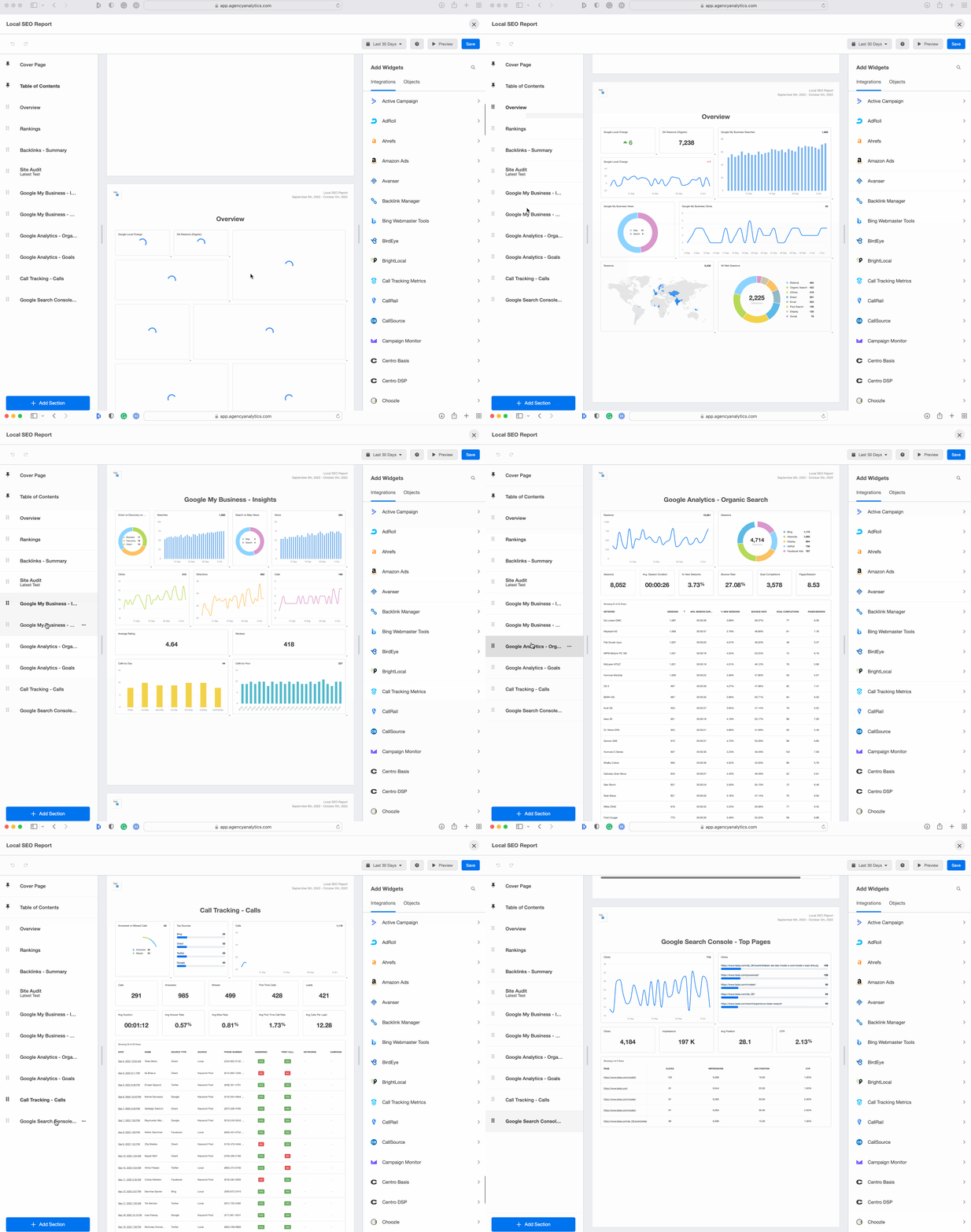
Use an SEO report template or a local SEO report template to demonstrate the value your agency brings. Try AgencyAnalytics free for 14 days!
9. Let your clients choose the way they’ll learn
Everyone learns differently. To get the best results with a client, determine or simply ask which of the four primary learning styles they are most comfortable with: visual, auditory, reading/writing, or kinaesthetic.
Some clients want to work with a diagram, chart, or simple drawing. Others want to discuss their ideas in person or over the phone.
Some need you to demonstrate the concept on a computer or use an analogy. There will also be those who learn a thing or two on their own and then come to you for further explanation. Be prepared for any of these situations and, most importantly, be patient with your client, especially when their learning style differs from your own.
It never hurts to start your tutoring sessions by explaining some basics:
Defining the SEO acronym.
How search engine optimization helps rank websites higher on a page.
How domain authority gives search engines a method to rank a site’s importance.
Bonus tip
After establishing a collaboration with your client and once the results start rolling in, introduce more SEO-friendly elements into the mix. Talk to your client about the benefits of blogging, omnichannel marketing, running regular SEO checkups, and potentially creating another website.
Emphasize the role of email marketing in nurturing leads and building trust, which further supports the SEO strategy. Don’t mislead your client into thinking SEO is ever done, because you know it never is.
Over the long run, active SEO marketing brings them more business and a successful client collaboration for you.
Final thoughts on setting SEO expectations
Setting realistic SEO expectations is vital for maintaining strong client relationships and achieving long-term success in your campaigns. This guide covered nine actionable strategies for managing client expectations, from educating them on the basics to explaining the timeline, grounding the pitch in research, and reporting on the metrics that matter.
It also debunked the common misconceptions about SEO, clarified why continuous effort is required, and set out how transparent communication holds it all together.
Building these strategies into your workflow manages the gap between client expectations and SEO reality, and strengthens your role as a trusted advisor. For seamless implementation, AgencyAnalytics SEO reporting tools help you show the work.
A professional client reporting platform offers comprehensive, easy-to-understand reports that keep clients informed and engaged, showing the real progress of your SEO efforts. With customizable dashboards, you present key metrics, track performance, and provide transparency, so clients see the value in your agency’s work.
Impress clients and save hours with custom, automated reporting.
Join 7,000+ agencies that create reports in under 30 minutes per client using AgencyAnalytics. Get started for free. No credit card required.

Already have an account?
Log inWritten by
Nick Chernets is the Founder and CEO of DataForSEO, the leading provider of marketing data. Just as much as he is passionate about data analysis and SEO — Nick also enjoys sharing his experience from the business side of the industry.
What other agency experts are reading

How To Get SEO Clients? 20 Experts Chime In
Even if your digital marketing agency begins to scale and you’re ready to onboard more SEO clients, where exactly do you find them? We surveyed 20 industry-leading experts to answer this question for you.


How to create SEO reports for clients that drive real results (+ 2026 template & examples)
Discover how to build client-ready SEO reports that highlight progress, reinforce strategy, and prove your agency’s value.