18 best marketing automation tools in 2026


Table of Contents
- Key takeaways
- What is marketing automation?
- What are marketing automation tools?
- Automating client management vs. the manual approach
- Key benefits of marketing automation tools
- Does your agency need an automation tool?
- How to choose the right marketing automation software
- Groundwork to do before you shortlist
- 18 marketing automation tools every marketer needs to know
- Use marketing agency automation tools to unlock operational effectiveness
- FAQs About Marketing Automation Tools
7,000+ agencies have ditched manual reports. You can too.
Free 14-Day TrialTable of Contents
- Key takeaways
- What is marketing automation?
- What are marketing automation tools?
- Automating client management vs. the manual approach
- Key benefits of marketing automation tools
- Does your agency need an automation tool?
- How to choose the right marketing automation software
- Groundwork to do before you shortlist
- 18 marketing automation tools every marketer needs to know
- Use marketing agency automation tools to unlock operational effectiveness
- FAQs About Marketing Automation Tools
7,000+ agencies have ditched manual reports. You can too.
Free 14-Day TrialYour agency has hit its growth goals, and the energy is electric. Clients are lining up, projects are flowing, and the office is buzzing with activity. It’s exactly what you dreamed of, until the cracks start to show.
Suddenly, fulfilling client requests and managing internal operations takes longer than ever. That trusty master spreadsheet you relied on for client tracking? It’s not cutting it anymore. Overdue deliverables, missed invoices, and inconsistent marketing results are piling up, leaving clients frustrated and questioning what went wrong.
You’ve felt the strain: the endless toggling between tools, the late nights tweaking client decks, the burnout that comes from doing too much of what software should have handled in the first place. Manual reporting, status updates, and scattered feedback loops eat into the hours that should be spent driving strategy and growth.
That’s where marketing automation comes in. The right platforms take low-value admin work off your team’s plate, deliver real-time visibility to clients, and keep your agency running smoothly even when you’re juggling dozens of accounts.
I understood the value of having sound systems to communicate and track work. Infrastructure building helped us grow because there wasn’t wasted time searching for something stuck in one person’s email inbox. It also allowed us to become more responsive to clients, which leads to better quality work.
Yanira M. Castro, CEO, Humanity Communications Collective
The result? Less billable time wasted, more business, and happier clients. This guide covers what marketing automation does, what agency leaders should look for in a platform, and the 18 tools worth shortlisting in 2025.
Key takeaways
Automation handles the recurring work (client onboarding, scheduled reports, follow-ups, task assignments) so your team spends its hours on strategy, creativity, and growth.
Manual checklists and spreadsheet trackers hold up at five clients and break at 20, where one missed follow-up or outdated report chips away at retention.
Choose software on six criteria: agency-specific multi-client functionality, workflow automation across departments, ease of setup, CRM and platform integrations, reporting that proves ROI, and pricing that scales.
Most of the 18 tools below specialize in one area (email, social, CRM, ads, or AI), so most agencies end up running a few together rather than one platform for everything.
Whichever stack you choose, consolidate the results in one place: AgencyAnalytics reports pull live data from 85+ platforms, update automatically, and send on schedule under your brand.
What is marketing automation?
Marketing automation uses software to simplify repetitive tasks, manage campaigns, and boost efficiency across multiple channels. It allows your agency to focus on strategy and creativity while letting the tools handle the heavy lifting. Digital agency tools can fill gaps in analytics, dashboards, and collaboration.
At its core, marketing automation is about building scalable systems. Whether scheduling social media posts, nurturing leads, or generating reports, these tools ensure your workflows run smoothly and your clients see measurable results.
What are marketing automation tools?
Marketing automation tools are purpose-built platforms that help agencies save time and work more effectively.
These tools streamline your workflows by automating tasks such as follow-up emails and social media scheduling. They also allow you to create automated workflows that enhance efficiency and ensure consistency across campaigns, and help you track success through real-time analytics.
Additionally, marketing automation tools allow for personalized campaigns by delivering content tailored to specific client needs or audience behaviors. Finally, they make collaboration seamless by centralizing and unifying marketing analytics data and workflows, keeping your team aligned and productive.
Whether you use comprehensive platforms like HubSpot or specialized tools like Mailchimp, these solutions are designed to help your agency scale without overloading your team.
Automating client management vs. the manual approach
Manual marketing processes might have worked when you had five clients. But once you’re juggling 20 or more, it’s not just inefficient. It’s risky.
Think about it: one missed client email, one outdated report, or one forgotten follow-up can shake trust and chip away at retention. And those manual checklists and spreadsheet trackers? They don’t scale. Our guide to tools for marketing agencies helps standardize the systems that prevent these gaps.
Client automation flips the script.
Instead of chasing updates or assembling reports by hand, your team focuses on what they do best: strategy, creativity, and growth. Automation tools handle the recurring work (client onboarding, scheduled reports, follow-ups, task assignments) without the lag or human error.
And it’s not just about saving time. It’s about showing up consistently, staying ahead of client questions, and proving value without burning out your marketing team. That’s the difference between agencies that plateau and the ones that grow.
Key benefits of marketing automation tools
Here’s what the right marketing automation tools do for your agency:
Save time: Automate repetitive tasks so your team focuses on high-level strategy for clients.
Ensure consistency: Keep campaigns on track and meet deadlines without relying on manual processes.
Support growth: Manage more clients and campaigns without overburdening your team.
Leverage data: Use real-time insights to make smarter decisions and optimize strategies.
Deliver personalization: Create tailored campaigns that boost engagement and results.
These tools also improve lead management, helping agencies prioritize and nurture leads through the funnel while reducing manual effort.
Does your agency need an automation tool?
You may be wondering whether your agency really needs automation tools. If you’re serious about growth and efficiency, the answer is yes.
An increase in clients comes with increased deliverables. Plus, you may have more employees, overheads, or even freelancers to manage. Without proper automation tools in place, it becomes challenging to manage marketing tasks and exceed client expectations.
To break it down further, investing in the right tool:
Eliminates repetitive manual tasks: Free up more time to focus on high-level, strategic work.
Leads to sustainable business growth: As more projects come through the pipeline, a marketing automation solution increases your bandwidth and ensures operational efficiency.
Increases your agency’s profitability: The right automation software means you won’t have to onboard additional staff or pay for extra overheads just to get the job done. It also provides a systematic way to track billable hours and your agency’s pricing.
Once we understand our processes, workflows, and staffing needs for every project and initiative, we price our services with profitability.
Rodrigo Campos, Founder & CEO, Splurge Media
How to choose the right marketing automation software
Client relationships are the heartbeat of any marketing agency. But when your team is stretched thin, even the best client work gets buried under a mountain of manual tasks, patchy systems, and missed follow-ups.
To choose marketing automation software that will truly offer maximum benefit to your agency, keep the following six factors in mind.
1. Agency-specific functionality
Agencies live in a multi-client world. Generic software doesn’t. Most other tools weren’t built to do the heavy lifting of juggling multiple accounts, branded experiences, and different reporting needs all at once. They force you into one-size-fits-none workflows that don’t scale.
You need software that understands your reality: switching between 30 client dashboards a day, building performance reports on deadline, and staying responsive without burning out your team.
AgencyAnalytics streamlines multi-client management by offering a centralized dashboard for agencies, with individual login access for each client to view their specific dashboards. Build white labeled reports that look like they were made in-house, and workflows tailored for agency teams.

Give each client their own secure, branded login and show them exactly what they need to see. Try AgencyAnalytics free for 14 days.
2. Workflow automation across departments
Client relationships don’t break down because of one big issue. They break down from dozens of small delays and disconnects: a missed onboarding step, a late deliverable, a forgotten report.
That’s what workflow automation fixes. Automated processes create a safety net across your agency, so tasks are assigned on time, emails go out automatically, and nothing falls through the cracks.
The best marketing tools connect every department: strategy, accounts, execution, and reporting. When everything is in sync, your agency doesn’t just feel more efficient. It is more reliable. And clients experience that difference immediately.
3. Ease of setup and use
Your clients won’t wait for you to “get up to speed.” They expect seamless onboarding, fast turnarounds, and consistent updates. If your automation software requires weeks of training or constant troubleshooting, it’s a liability.
Look for tools that offer intuitive dashboards, drag-and-drop automation builders, and pre-built templates that eliminate the guesswork. Your team should be able to hit the ground running, and your clients should see the benefits right away.
4. CRM and marketing platform integrations
Client communication lives in email, ad platforms, CRM tools, and project management systems. If your automation software doesn’t unify those channels, your client data stays fragmented, and that creates blind spots.
You need one platform that integrates marketing performance, CRM activity, and communication history. You want software that enables you to track lead generation and customer engagement insights without losing the big picture, switching between tools, or jumping from one app to another. That visibility powers better strategy, faster answers, and smarter decisions.
Every touchpoint (clicks, emails, meetings, conversions) should be tracked and accessible from one place. When a client asks what’s working, you don’t guess. You show them.
5. Reporting that demonstrates agency ROI
Your clients want to know two things: “What did you do?” and “Did it work?”
If your client reporting software doesn’t answer both questions visually and automatically, it’s holding you back. Manual reporting leads to delays, errors, and vague updates that erode trust.
AgencyAnalytics eliminates that risk. Reports pull live data from 85+ platforms, update automatically, and can be scheduled to send before your client even asks. It’s the difference between reactive updates and proactive value.
And because the reports are white labeled, clients see your agency’s brand, not a third-party tool. You stay front and center.

Keep your agency front and center. Every report is fully branded with your logo, colors, and style, showcasing your agency’s polished, professional work. Start your free trial today!
6. Pricing that makes sense as you scale
Profit margins shrink fast when every new client comes with more software costs. Many platforms look affordable upfront, until you hit their limits and start paying for each additional user, seat, or feature.
Scalable pricing matters. Your automation platform should grow with you without surprising your finance team.
Groundwork to do before you shortlist
Before signing up for automation software, it’s worth doing some groundwork. You don’t want to end up with a tool that doesn’t meet your requirements. Here are the actionable steps to follow.
Step | Description |
|---|---|
Define your goals | Clearly outline what your agency needs in an automation tool (e.g., a platform to streamline agency project management). |
Prioritize features | Think about any non-negotiable advanced features, such as lead scoring or email A/B testing. |
Evaluate usability | Consider whether your agency has the time and capacity to learn a complex tool. If not, investing in an intuitive, user-friendly platform may be a better option. |
Set a budget | Carve out a realistic budget, factoring in recurring costs and add-ons (if applicable). Explore various pricing tiers in case your agency outgrows that chosen plan. |
Check integrations | Explore your currently used tools and determine whether specific integrations are needed (e.g., a CRM integration or functionality with messaging apps). |
Research support | Research whether this tool offers adequate customer support, training, and resources (e.g., a comprehensive help center). |
After this foundational work, narrow your options and consider a trial (if available). That way, you’ll get a feel for the marketing automation platform before taking the leap.
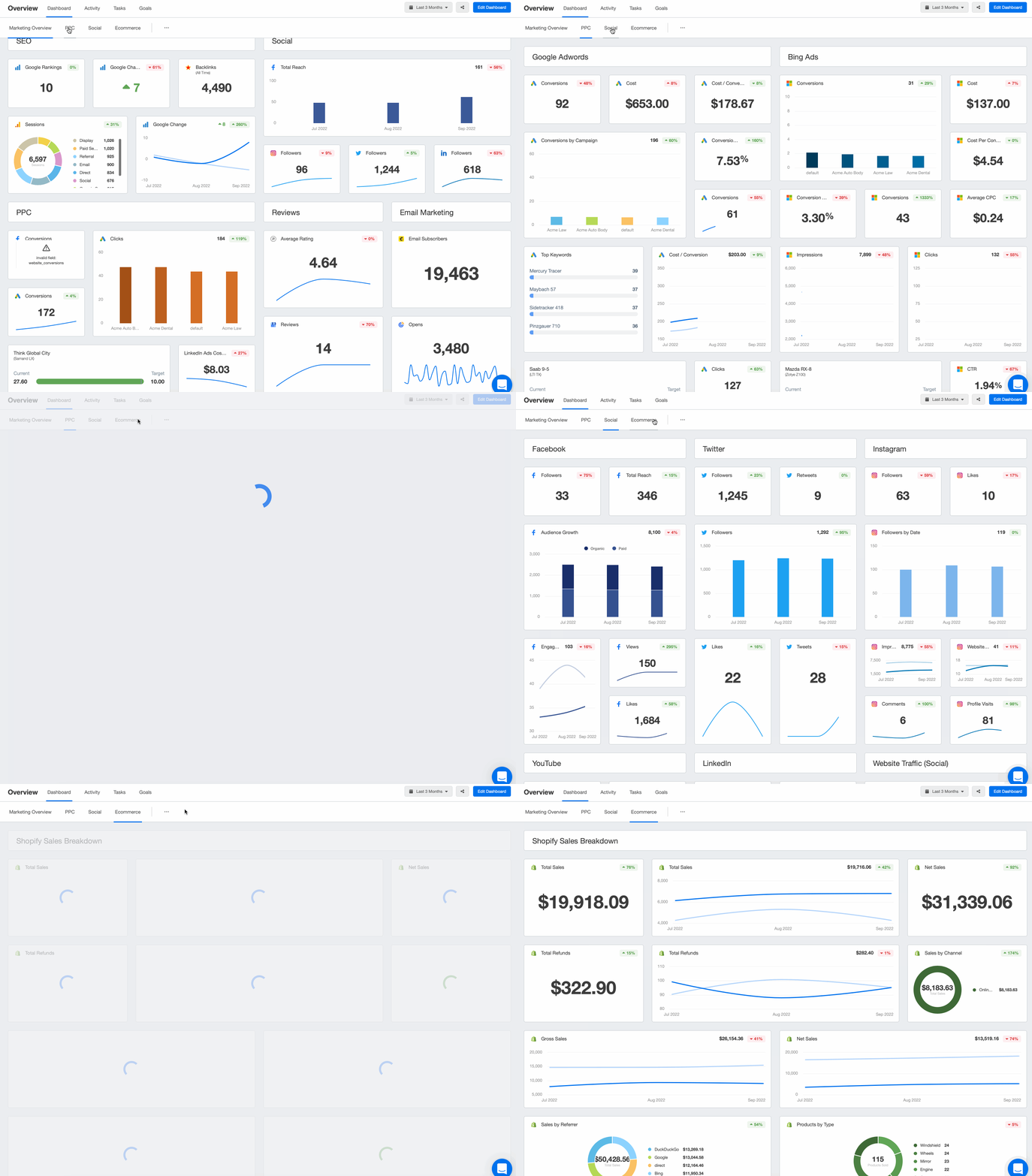
Easily monitor the progress of your clients’ digital marketing strategies. Invest in a platform with 24/5 customer support and over 85 integrations. Try AgencyAnalytics today, free for 14 days.
18 marketing automation tools every marketer needs to know
Now that the basics are covered, here’s the list. Each tool below was selected for agency relevance in 2025, whether it streamlines client management, automates workflows, or delivers consistent value without adding headcount.
1. AgencyAnalytics
AgencyAnalytics is designed specifically for marketing agencies. It automates client reporting by consolidating data from multiple platforms into custom dashboards and reports, saving agencies time and improving client communication.
With its intuitive interface and over 85 integrations, AgencyAnalytics streamlines workflows for busy teams. Agencies use white-label features to create professional, branded reports that highlight ROI and campaign success in just a few clicks.
New features like 11-Second Smart Reports and Ask AI take reporting to the next level. Smart Reports generate detailed client reports using connected campaign integrations, featuring top-used metrics based on the reporting patterns of over 7,000 agencies, in as little as 11 seconds. With Ask AI, agencies uncover actionable insights in seconds, identifying trends, growth opportunities, and areas for optimization.
The platform also includes Marketing Performance Insights, which compares client campaign performance against benchmarks from over 150,000 campaigns. These tools help identify risks, predict outcomes, and set realistic goals to maximize marketing ROI and effectively showcase results to clients.

Use AgencyAnalytics’ advanced features—benchmark comparisons, anomaly detection, and data forecasting—to push client performance past the competition. Try it free today!
2. HubSpot
HubSpot is an all-in-one marketing hub with features like email marketing, CRM, and analytics tools that work seamlessly together. It’s a strong choice for agencies that want a single, reliable platform to manage their campaigns and client relationships.
HubSpot is designed for scalability and offers pricing tiers to fit small agencies and enterprise-level operations. With its customizable workflows and AI-powered tools like a paragraph rewriter and social media caption generator, HubSpot helps agencies automate processes and engage more effectively with clients.
Known for its intuitive interface, HubSpot is easy to navigate for teams of all skill levels. Use built-in dashboards to track campaign performance, optimize ROI, and deliver actionable insights. Plus, with resources like the HubSpot Academy and 24/7 customer support, agencies can get the most out of the platform.
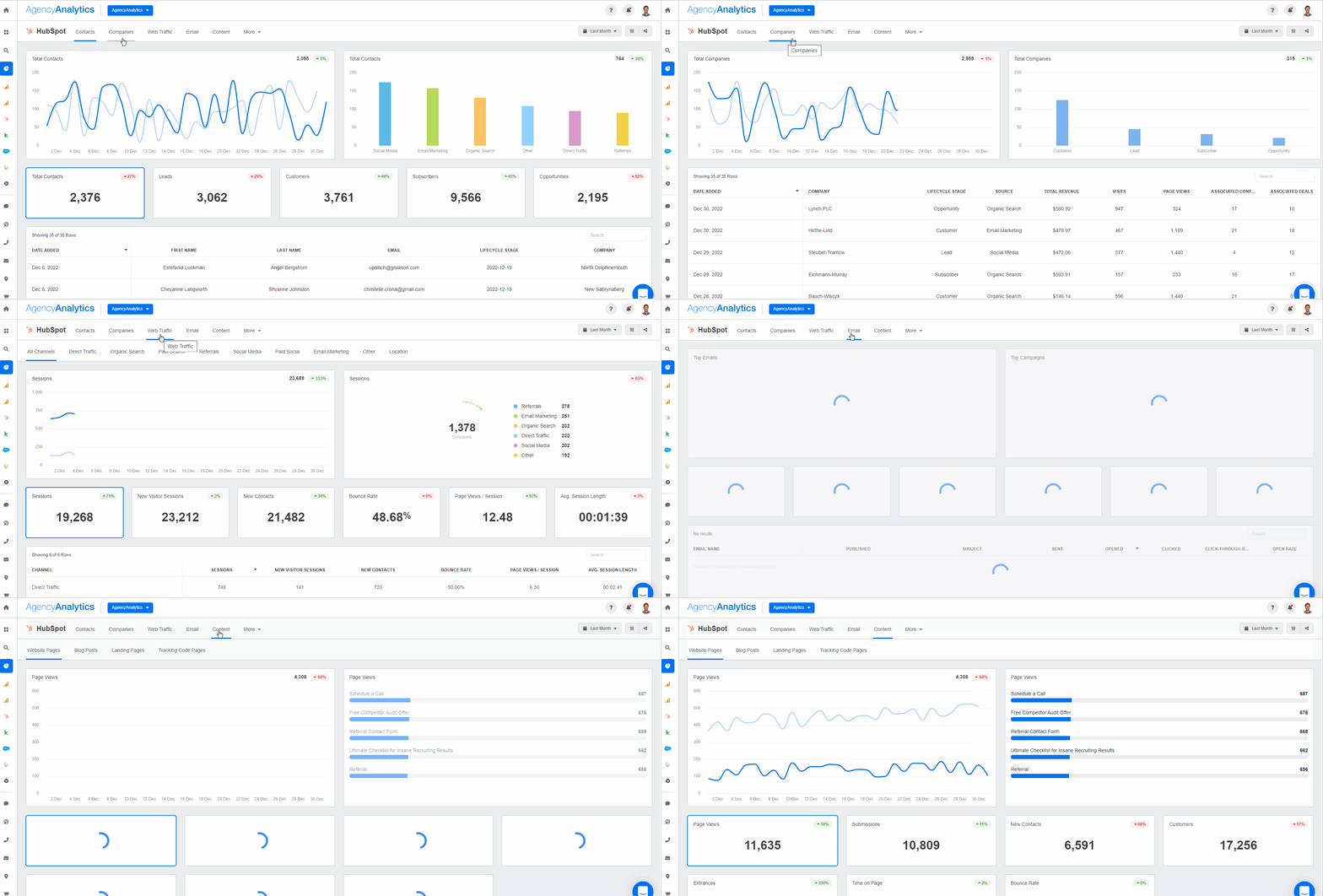
This platform comes with an extensive range of in-platform data, which gets complex even for advanced marketers. For a more simplified approach, use a visual HubSpot dashboard for easy reference.
3. ActiveCampaign
ActiveCampaign is an email marketing and automation platform that prioritizes personalization and customer engagement. With its robust automation capabilities, it’s a good fit for agencies delivering targeted, data-driven campaigns.
Designed to scale with your agency’s needs, ActiveCampaign offers flexible pricing and features that support both small teams and growing businesses. Its automation tools include AI-driven features like predictive email sends and advanced workflows, making it easy to tailor campaigns to specific client journeys.
Known for its ease of use and personalization, ActiveCampaign’s segmentation tools help agencies target the right audience. For a streamlined approach, use its detailed reporting tools to track engagement, conversions, and campaign performance.
To keep on top of email performance, stream ActiveCampaign metrics into an interactive dashboard. That way, you’ll see the big picture without having to log into the platform each time.

4. Brevo
Brevo, formerly known as Sendinblue, is a versatile marketing automation platform built to help agencies scale their efforts effectively. With features like email and SMS marketing, it offers an all-in-one solution for creating cohesive, multi-channel campaigns.
Designed for affordability, Brevo provides budget-friendly pricing plans without sacrificing essential features. It’s a good fit for small to mid-sized agencies managing diverse client needs. Its drag-and-drop editor makes designing emails, landing pages and forms simple, even for teams without design expertise.
Brevo’s lightweight CRM helps agencies track client interactions and streamline communication. For actionable insights, its real-time analytics make it easy to monitor campaign performance and refine strategies as needed.
For more scalable data tracking, use the Brevo integration in AgencyAnalytics. That way, you’ll have oversight of your clients’ email campaigns alongside insights from other marketing platforms. Check out the integration here.

5. SharpSpring
SharpSpring is a marketing automation tool built for agencies that need advanced lead generation and sales integration capabilities. With its ability to build and track marketing funnels, it’s a reliable option for driving client growth.
Designed for flexibility, SharpSpring supports teams with diverse portfolios through features like white labeling and multi-client management. Its drag-and-drop editor makes creating high-converting landing pages simple, while its detailed analytics provide valuable insights into campaign performance and ROI.
SharpSpring’s built-in CRM aligns sales and marketing efforts, ensuring smooth transitions between teams. For agencies focused on revenue growth strategies, this platform offers a cost-effective way to manage campaigns and nurture high-value leads.
SharpSpring is useful for any client with a revenue growth marketing strategy (e.g., retail and ecommerce). To get the most from these insights, use the SharpSpring integration in AgencyAnalytics to monitor campaigns and how they contribute to the bottom line.

6. Mailchimp
Mailchimp is a versatile email marketing platform that offers features such as landing page creation, an AI-driven Content Generator, and workflow automation.
Designed for scalability, Mailchimp supports business growth with tiered pricing, which means there won’t necessarily be a need to switch platforms later on. While this platform caters to businesses of all sizes, it doubles as a great starter CRM for smaller clients.
Mailchimp is also known for its user-friendly drag-and-drop editor, which helps if your marketing team doesn’t have a design expert. For a time-efficient approach, use an automated Mailchimp dashboard to monitor email marketing metrics and make informed recommendations.

7. Constant Contact
Constant Contact is a popular email marketing platform known for its simplicity and ease of use. This platform integrates with various CRM systems, social media platforms, and other third-party tools. That means it’s easier for agencies to create integrated campaigns and streamline workflows across multiple platforms.
Leverage Constant Contact’s automation features to send targeted messages, segment audiences, and create re-engagement campaigns. This ensures email content is delivered at the right time, leading to better results.
If your agency specializes in event marketing, Constant Contact is a strong option for managing guest lists, registration, and promotions.
If you have multiple clients who use this platform, use the Constant Contact integration to create visually populated dashboards automatically.

8. Drip
Drip is an email marketing platform built with ecommerce in mind. This tool seamlessly integrates with Shopify, Stripe, and PayPal (to name a few), making it an ideal option for your clients primarily focused on online sales.
Another plus is that Drip doesn’t require any previous coding experience. This makes it easy to create a complex automation workflow (e.g., a Shopify-oriented Drip campaign), capture valuable customer data, and drive more conversions.
Use an automated Drip dashboard to monitor email campaigns and understand the entire customer journey.

9. Klaviyo
Another top-rated email marketing tool is Klaviyo, which seamlessly integrates with ecommerce platforms like Shopify and WooCommerce. It also offers advanced A/B testing, ideal for large-scale ecommerce clients who want to experiment with different elements (e.g., subject lines, copy).
This marketing automation tool also offers custom solutions for the retail, wellness, and restaurant industries. Therefore, it may be a great option if your agency specializes in any of these niches.
With Klaviyo AI, it’s also possible to create customer journey segments and optimize signup forms, which leads to better customer engagement. The Klaviyo integration in AgencyAnalytics allows you to view these insights alongside marketing data from more than 85 platforms.

10. Albert.ai
Albert.ai is a marketing automation platform powered by artificial intelligence and a strong choice for agencies managing complex, multi-channel campaigns. It excels at real-time optimization, automatically adjusting ad campaigns across social media, search, and display ads to maximize performance and ROI.
The platform is particularly beneficial for agencies developing marketing automation strategies for clients in fast-paced industries where quick adjustments and precision targeting are key.
Albert’s AI capabilities also simplify testing and optimizing creative elements, ensuring personalized marketing campaigns resonate with potential customers.

11. ChatGPT
ChatGPT is a popular AI tool that works alongside other marketing automation tools to create smarter, more human-like interactions across different channels. It simplifies communication workflows, automates responses, and generates personalized content for specific audiences.
It helps craft sales funnel content, improve ad copy, and support email marketing efforts. It’s a simple way for agencies to boost engagement and handle complex campaigns more effectively.
ChatGPT helps agencies and small businesses save time and scale their efforts by automating repetitive tasks and improving content creation. It’s a good option for marketers looking for a flexible, AI-powered tool to enhance their workflows.

12. Improvado
Improvado simplifies marketing automation by consolidating data from multiple marketing channels into a single platform. It’s ideal for agencies needing automated marketing reports, custom dashboards, and advanced analytics to track performance and optimize strategies.
This platform supports integration with other tools, such as Salesforce Marketing Cloud and HubSpot Marketing Hub, making it easy to maintain the same automation workflow across different systems.
By streamlining data collection and reporting, Improvado helps agencies focus on improving campaigns and delivering results.

13. Zoho
Zoho is a marketing software that combines automated CRM features with email, social media, and push notifications. It’s a flexible option for small businesses and enterprise brands looking to simplify workflows and manage campaigns more effectively.
Category: Marketing automation
Best for: Small to mid-sized agencies seeking an affordable solution
Key features:
Lead management and scoring
Email marketing automation
Social media marketing
Web behavior tracking
A/B testing and analytics
Pricing: Starts at $14.99/month
With tools for automation triggers, Zoho helps agencies set up workflows for lead nurturing, customer engagement, and campaign management. Its reporting features make tracking performance and refining strategies easy, while its content marketing tools simplify creating and sharing personalized campaigns.
Email, social, and on-site behavior data feed directly into its automation engine, allowing for real-time triggers and lead scoring. Teams rely on it to boost efficiency without stretching the budget. Backed by a responsive support team and scalable services, Zoho simplifies onboarding for smaller agencies.
Whether you’re managing a sales funnel or handling ecommerce marketing, Zoho offers scalable solutions to fit a variety of needs. It’s a solid choice for agencies wanting to streamline their processes and improve results.

14. Salesforce
Another CRM powerhouse is Salesforce, which houses extensive databases, creates marketing campaigns (e.g., social media and email), nurtures leads, and manages sales pipelines.
Salesforce consolidates contact information, displays an agency-client communication history, and stores project details in one place. It also has a built-in Einstein AI solution that helps create personalized copy, score the most viable leads, and more.
This platform is ideal for enterprise-level agencies that manage a large volume of clients and sales pipelines. It’s also beneficial if you’re serving a highly regulated niche (e.g., financial services), as Salesforce offers industry-specific solutions. Instead of getting lost in a flurry of data, use a real-time Salesforce dashboard and streamline pipeline management.
For agencies running large-scale, data-driven campaigns, Salesforce Marketing Cloud is the enterprise tier of the same ecosystem.
Category: Enterprise marketing automation
Best for: Large-scale, data-driven marketing campaigns
Key features:
Cross-channel campaign management
Audience segmentation and targeting
Predictive analytics and AI integration
Personalized customer journeys
Robust reporting and dashboards
Pricing: Custom pricing based on needs
Salesforce Marketing Cloud gives agencies full pipeline management visibility and oversight of the entire customer journey from one platform. Its AI-driven engine automatically adjusts messaging across channels based on user data, while deep segmentation tools ensure pinpoint targeting. Enterprise-grade analytics and security make it a trusted choice for national and global client work.

15. Pipedrive
Pipedrive is a sales-focused CRM that integrates well with marketing automation tools. It helps agencies align their marketing systems with sales goals, making it a popular choice for small businesses looking to streamline workflows and manage online marketing automation effectively.
This platform makes setting up automation triggers for lead nurturing and campaign management easy. Its reporting features and marketing tools provide useful insights to improve strategies and track ROI.
Pipedrive also includes an AI-powered CRM designed to save time and boost productivity by identifying high-potential deals and recommending next steps.
With flexible options for growing teams, Pipedrive is a practical choice for agencies managing multiple clients or scaling up their operations.

16. Hootsuite
When it comes to a social media automation tool, Hootsuite is one of the industry leaders. It’s got everything your agency needs to coordinate social media campaigns, schedule posts, and monitor engagement.
Hootsuite also offers the ability to see brand mentions and a social media AI writer. This platform is ideal if your agency manages a significant number of social media clients across various platforms.
Another bonus is that you’ll be able to get client approval in-platform. Hootsuite allows social media ad scheduling (e.g., Facebook Ads, Instagram Ads), which is ideal if clients typically request various social media services.

17. Buffer
Similarly, Buffer is a social media management tool that supports scheduling, analytics, and engagement across various platforms. In addition, this tool has a mobile app and a handy AI assistant for content creation.
Buffer was made with small businesses in mind, offering a generous range of features for a free account (like scheduling ten social media posts for up to three channels).
Therefore, this may be a good choice for growing agencies with a handful of social clients, before eventually paying for premium features.

18. SocialPilot
SocialPilot is a social media automation tool that helps agencies and small businesses easily manage social campaigns. It’s an all-in-one platform for scheduling, publishing, and analyzing content across multiple channels, making it a great fit for agencies with a variety of clients.
The platform simplifies workflows and makes social media content creation more efficient. Its scheduling tools ensure consistent posting, and the built-in analytics help refine strategies to improve performance.
Affordable and easy to use, SocialPilot integrates with major social platforms and offers customization options to fit each client’s unique needs.

Use marketing agency automation tools to unlock operational effectiveness
Automated marketing platforms aren’t just nice to have. They’re necessary for all growth-oriented agencies. From streamlining email marketing campaigns to creating in-platform ads, they free up your billable time and optimize marketing processes.
To choose the best marketing automation software, consider your agency’s needs. Then, look for a tool with the desired features and the capacity to grow with your agency.
Whether you decide on one marketing automation platform or a few, monitoring results across all these tools is important. There’s no need for excessive manual work. Use AgencyAnalytics’ reporting capabilities to consolidate that data in one place.
AgencyAnalytics makes it easy to:
Automate data retrieval across 85 marketing tools.
Access pre-built dashboards and report templates.
Grant clients login access to live dashboards.
Create 11-second Smart Reports.
Deliver automated marketing reports like clockwork.
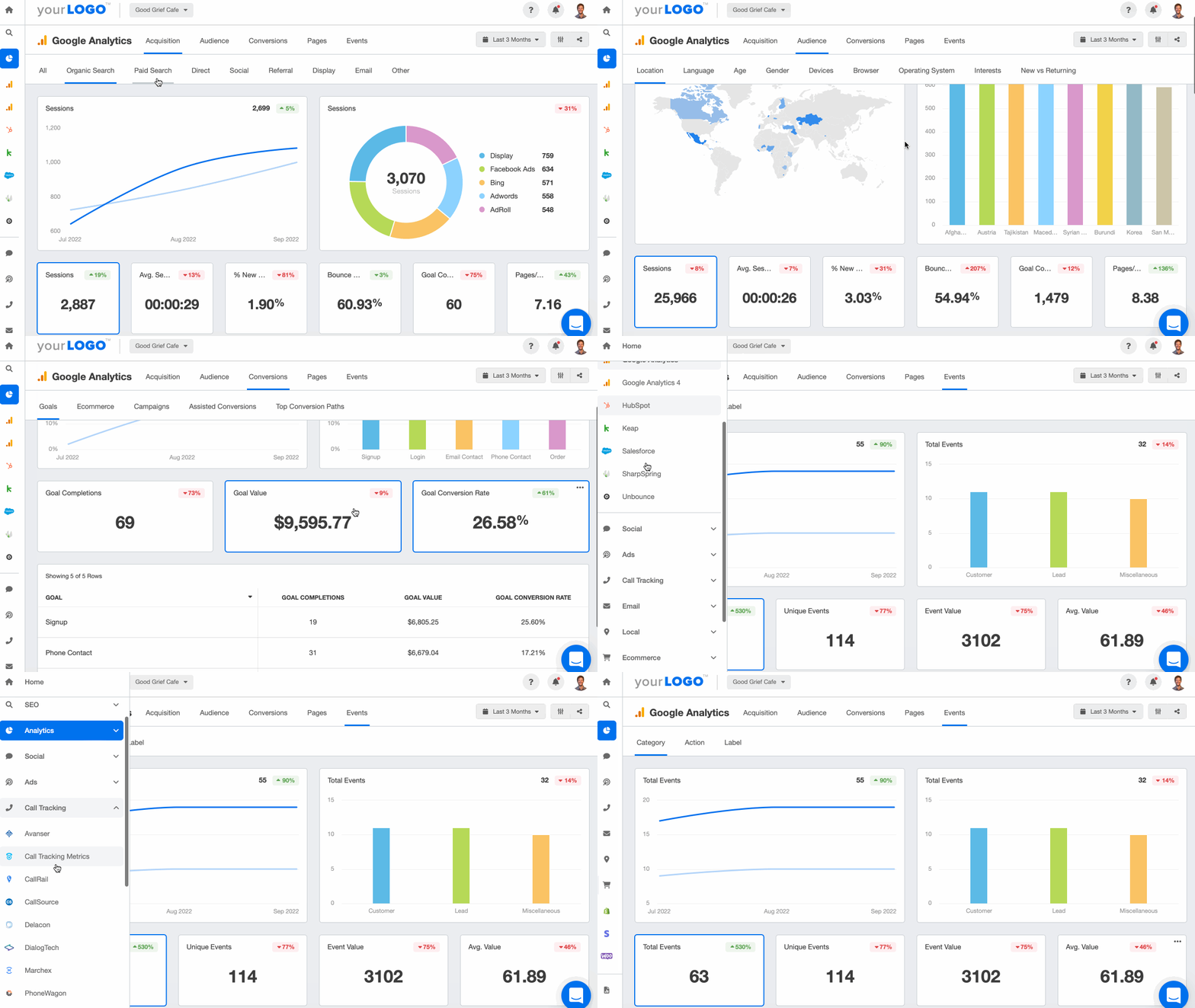
Streamline marketing automation efforts and invest in a sustainable reporting solution. See why AgencyAnalytics is trusted by 7,000 agencies and counting—try it free for 14 days.
Impress clients and save hours with custom, automated reporting.
Join 7,000+ agencies that create reports in minutes instead of hours using AgencyAnalytics. Get started for free. No credit card required.

FAQs About Marketing Automation Tools
Still have questions about how to effectively use marketing automation tools at your agency? Don’t worry, we’ve got you covered!
Marketing automation tools streamline repetitive marketing tasks like email campaigns, social media posting, and lead nurturing. They help agencies save time, improve efficiency, and optimize client campaigns using data-driven insights.
Compare tools based on features, integrations, ease of use, pricing, and scalability. Look for AI-driven insights, multi-channel automation, and customizable workflows. AgencyAnalytics integrates with key marketing tools, offering centralized reporting for data-driven decisions.
AI-powered marketing automation tools enhance personalization, predictive analytics, and workflow automation. Some of the most popular AI-driven tools include AgencyAnalytics AI Reporting Tools for AI-driven insights to streamline client reporting, HubSpot for AI-driven email personalization and workflow automation, ActiveCampaign for predictive lead scoring and behavior-based automation, Drift for AI-powered chatbots that improve customer engagement, Seventh Sense for AI-optimized email send times that boost engagement, and Persado for AI-generated marketing messaging that enhances conversions.
Marketing automation tools save time, reduce errors, and improve campaign performance. They allow agencies to focus on strategy instead of manual tasks, delivering personalized experiences at scale while improving ROI.
Start by defining goals, segmenting audiences, and automating repetitive tasks like email sequences and social scheduling. Use analytics to track performance and optimize workflows. With AgencyAnalytics, agencies automate reporting and track marketing data in real time.
Agencies automate client campaigns by integrating email, social media, lead nurturing, and CRM data into a unified platform. Automating workflows enhances efficiency, scales operations, and ensures data-driven decision-making.
Faryal Khan is a multidisciplinary creative with 10+ years of experience in marketing and communications. Drawing on her background in statistics and psychology, she fuses storytelling with data to craft narratives that both inform and inspire.
Read more posts by Faryal KhanWhat other agency experts are reading

Best marketing analytics tools for agencies in 2026: Features, pricing & reviews
Compare the best marketing analytics tools for agencies, including features, pricing, integrations, and reporting use cases to find the right fit.

The 60+ best marketing agency tools in 2025
Explore 60+ essential tools for marketing agencies—from content and social to analytics and automation—to streamline workflows, boost performance, and scale your agency.

How to create an email marketing report: The official 2025 guide
Learn how to build a high-performing email marketing report. Track opens, CTRs, conversions, and more, then add context, benchmarks, and automation to optimize campaigns.